
1. Introduction
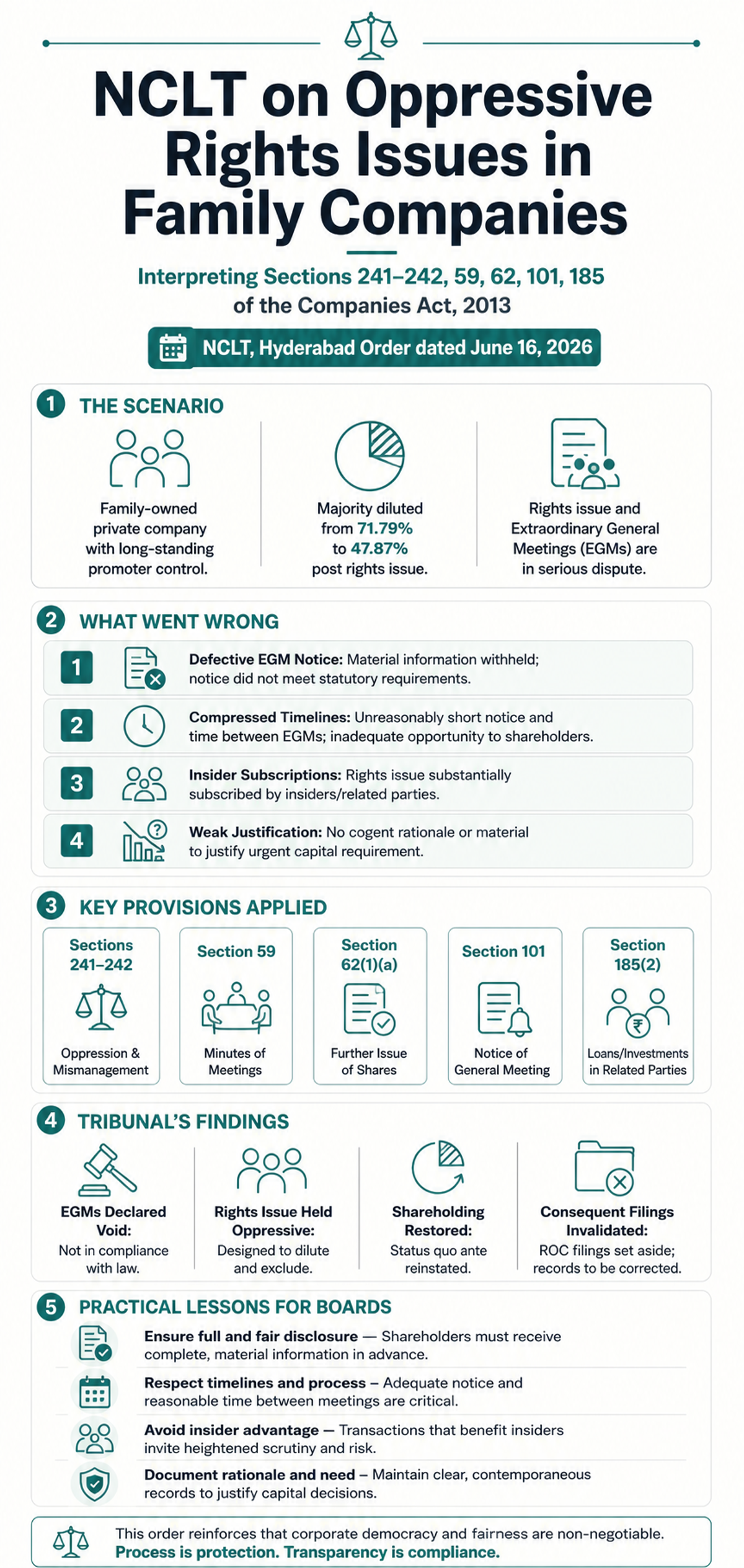
The National Company Law Tribunal, Hyderabad Bench, in Ashok Kumar Mandhani & Ors v. MBG Commodities Pvt. Ltd. & Ors (Order dated 16 June 2026), has delivered an important ruling on how rights issues and intra‑family capital restructurings can cross the line into oppression and mismanagement under Sections 241–242 of the Companies Act, 2013. The judgment squarely addresses a situation where a majority family group (71.79%) was reduced to a minority (47.87%) through a rights issue structured and executed by a rival branch in control of the board.
2. Brief
MBG Commodities Pvt. Ltd. was a closely‑held, family‑run company with shareholding spread across three branches of the Mandhani family, with Branches I and II together holding 71.79% prior to the impugned events. Over time, representatives of Branches I and II resigned from the board, leaving Respondent Nos. 2–4 (Branch III and independents aligned to that branch) in effective control of management.
Two clusters of decisions were challenged:
- An EGM on 06.01.2025 authorising loans/guarantees to related entities under Section 185, allegedly without valid notice or quorum.
- A rights issue approved on 09.06.2025 and implemented via an EGM on 28.06.2025, pursuant to which 2,49,95,000 shares were allotted almost entirely to Respondent Nos. 5 and 6 (wife and daughter of Respondent No. 2), diluting the petitioners’ holdings from 71.79% to 47.87%
The petition was brought under Sections 241–242 read with Section 59 and 213, challenging the rights issue, the EGMs, and consequential MCA filings (PAS‑3 and MGT‑14), and seeking rectification and investigation.
3. Issues before the Tribunal
While several allegations were raised, the Tribunal’s core focus for final relief was on three questions:
- Whether the EGMs dated 06.01.2025 and 28.06.2025 were validly convened and held, particularly regarding service of notice, quorum and compliance with Section 101.
- Whether the rights issue and allotment complied with Section 62(1)(a) of the Companies Act, Rule 12A of the Companies (Share Capital and Debentures) Rules, 2014, and analogous expectations under the SEBI ICDR Regulations (Regulation 106I).
- Whether the rights issue and allotment, in the manner carried out and in light of its effect on control, constituted oppression and mismanagement under Sections 241–242, attracting rectification under Section 59.
4. Statutory framework: Sections 241–242, 59, 62, 101 and 185
4.1 Oppression and mismanagement threshold
The Tribunal reiterated that relief under Section 242 requires satisfaction of the twin conditions in Section 242(1)(a)–(b): (i) the affairs of the company are being conducted in a manner oppressive to any member or prejudicial to the interests of the company, and (ii) it would be just and equitable to wind up the company, but such winding up would unfairly prejudice the members, justifying alternative relief. The petitioners, holding 47.87% even post‑allotment (and 71.79% if the allotment is disregarded), met the eligibility threshold under Section 244(1), enabling the Tribunal to adjudicate the oppression complaint.
4.2 Rights issue and pre‑emptive rights under Section 62
Section 62(1)(a) codifies the pre‑emptive right of existing shareholders to subscribe to further issue of equity shares in proportion to their holdings, through a notice specifying the number of shares offered and prescribing a time not less than a statutory minimum for acceptance. Rule 12A, introduced in 2021, allows the offer period to be reduced from the original 15–30 day window to not less than 7 days (with an unchanged maximum of 30 days), thereby tightening—but not trivialising—the time for acceptance.
The Tribunal in MBG Commodities applied this framework and emphasised that the statutory period is not merely a formality; it embodies the substantive right of shareholders to preserve their voting power through proportionate subscription.
4.3 General meeting notice requirements under Section 101
Section 101 mandates clear notice of every general meeting, specifying place, date, hour and business, to every member, director and auditor, within the statutory time frame (21 clear days unless validly shortened). Failure to serve proper notice on substantial shareholders can, in appropriate cases, render the meeting and resolutions invalid. The Tribunal placed this requirement at the heart of its analysis, noting that defective service on a significant majority bloc is inherently oppressive and not a mere procedural irregularity.
4.4 Section 185: Member‑approved related party loans/guarantees
Section 185(2) requires a special resolution in a duly convened general meeting before granting loans, guarantees or securities to specified entities. The EGM of 06.01.2025, which purportedly authorised loans/guarantees to related entities aggregating to ₹25.05 crore, was scrutinised on this basis; the Tribunal found that the company failed to prove proper service of notice and quorum, rendering the resolutions unsustainable.
5. NCLT’s reasoning on invalidity of the EGMs
5.1 Failure to prove due service of EGM notices
For the 06.01.2025 EGM, the respondents relied on a notice dated 27.11.2024 seeking special resolutions under Section 185. However, they could not produce credible evidence of service on the petitioners or proof of quorum and actual convening of a valid meeting. The Tribunal held that in the absence of such evidence, member approval mandated under Section 185(2) was not properly obtained.
For the 28.06.2025 EGM authorising/recording the rights issue allotment, the respondents produced a notice dated 10.06.2025, postal receipts and tracking reports showing dispatch of envelopes, some of which were delivered on 18 and 19 June 2025 (the rights issue opening date was 19.06.2025). The Bench noted two problems:
- Tracking reports only evidenced dispatch and movement of envelopes with “indeterminate contents”; they did not conclusively prove that statutory notices in proper form were served.
- Even assuming delivery, receiving the notice on or just before the opening of the issue fundamentally undermined shareholders’ ability to exercise their rights meaningfully.
5.2 Case‑law relied on for notice‑based oppression
The Tribunal relied on:
- Hansraj Gokuldas Ved v. Nitin Dyeing & Bleaching Mills Pvt. Ltd. – where non‑service of AGM notice on substantial shareholders was held oppressive and sufficient to invalidate resolutions.
- Adbhut Vincom (P) Ltd v. Hotel Birsa (P) Ltd (NCLAT) – where omission to send notices for meetings resulting in capital increase was treated as oppression; resolutions increasing share capital in the absence of notice to a 49% shareholder were set aside.
- Varshben S. Trivedi v. Shree Sadguru Switch Gears Pvt. Ltd. – reiterating that service via UPC only creates a rebuttable presumption; if the shareholder denies receipt, the company must produce corroborative evidence of actual delivery.
Applying these authorities, the Bench held that non‑service/defective service of notice to a 71.79% shareholder group in a family company is itself oppressive and vitiates the EGMs.
6. Scrutiny of the rights issue under Section 62 and ICDR
6.1 Offer period and dispatch timelines
The rights issue in MBG Commodities opened on 19.06.2025 and closed on 27.06.2025—an 8‑day window. Letters of offer were said to be dispatched on 17.06.2025. The Tribunal noted that:
- Although Rule 12A permits a shorter window, the offer must remain open for not less than 7 days from the date of the offer, and the company must provide a real opportunity to respond.
- Dispatch just two days prior to opening, with some notices delivered as late as 19 June, effectively compressed the actual decision window for majority shareholders and did not meet the spirit of Section 62(1)(a) read with Rule 12A.
The Bench further referenced Regulation 106I of the SEBI ICDR Regulations, 2018, which requires that the abridged letter of offer and application form in a rights issue be dispatched at least three days before the issue opens. While MBG is not a listed company, the Tribunal used ICDR as a regulatory benchmark to highlight the unreasonableness of the company’s timelines.
6.2 Day‑one subscription to unsubscribed shares
On 19.06.2025—the very opening day—Respondent No. 5 subscribed not only to her own entitlement (49,76,850 shares) but also to the entire unsubscribed portion of about 1,79,46,600 shares, remitting approximately ₹45.84 crore to the company. The Tribunal emphasised that:
- Unsubscribed shares should become available only after expiry of the offer period and once it is clear that other shareholders have declined or not accepted their entitlements.
- A same‑day application for the full unsubscribed portion, when notices were allegedly still being delivered, indicated a pre‑designed outcome rather than a genuine “residual allocation” exercise.
This conduct, read with the compressed timelines, was central to the finding that the rights issue was used as a device to alter control rather than to raise capital legitimately.
6.3 Financial position versus claimed capital need
The petitioners pointed to audited financials for FY 2023–24 showing:
- Net worth around ₹255 crore;
- Cash and cash equivalents exceeding ₹151 crore (including ₹150 crore in fixed deposits);
- Trade receivables over ₹120 crore; and
- Net profit exceeding ₹26 crore.
Additionally, soon after the rights issue, the company purchased a Bentley luxury vehicle for about ₹8 crore. In the Tribunal’s view, these data points collectively undermined the narrative that there was a pressing working capital need necessitating a large rights issue that just happened to shift control.
7. Fiduciary limits on share issuance and control shifts
The Bench situated its analysis within long‑standing Supreme Court jurisprudence on the fiduciary nature of directors’ power to issue shares:
- Dale & Carrington Investment (P) Ltd v. P.K. Prathapan – holding that issuing further shares to convert a majority shareholder into a minority, against the Articles and without bona fide purpose, is an act of oppression.
- Rajendra Kumar Tekriwal v. Unique Construction (P) Ltd. – where selective notice to directors for meetings at which shares were allotted, reducing petitioners to a frail minority, was termed the “worst type of oppression”, and the allotments were cancelled.
- References were also made to classic English authorities (Howard Smith, Hogg v. Cramphorn) and Indian decisions like Needle Industries, TCS v. Cyrus Investments, and Shailja Krishna v. Satori Global to underline that share issuance cannot be used primarily as a takeover device under the garb of capital raising.
Relying on these, the Tribunal held that:
- The power to conduct a rights issue and to allot shares is fiduciary. It must be exercised for a proper purpose (genuine capital requirement) and in a fair, non‑oppressive manner.
- Where the “dominant purpose” is to dilute a particular shareholder group and consolidate control in insiders, especially through defective notices and truncated timelines, the exercise is oppressive and voidable.
8. Findings and final directions
On the cumulative facts, the NCLT concluded that:
- The EGMs dated 06.01.2025 and 28.06.2025 were convened without valid service of notice on the petitioner‑group, in violation of Section 101, and were therefore void; all resolutions passed therein were set aside.
- The rights issue process violated Section 62(1)(a) and Rule 12A (inadequate offer period and defective dispatch), and ran contrary to the spirit of ICDR Regulation 106I, evidencing a contrived process.]
- The resultant allotment to Respondent Nos. 5 and 6, which reduced the petitioners from majority to minority and shifted control to Respondent No. 2’s branch, constituted oppression within Sections 241–242 and was void.[]
Accordingly, the Tribunal:
- Declared the actions of Respondent Nos. 2–6, including the allotment and dilution, as acts of oppression.
- Set aside and cancelled the allotment of 2,49,95,000 shares to Respondent Nos. 5 and 6.
- Directed rectification of the register of members under Section 59 to restore the petitioners’ collective shareholding to 71.79%.
- Declared PAS‑3 (SRN AB5236552) and MGT‑14 (SRN AB2364408) as null and void, directing the RoC Hyderabad to remove them from MCA records.
9. Practical implications for promoters, boards and advisors
9.1 Rights issues in family and closely‑held companies
Practitioners often treat rights issues as “safe harbours” against dilution‑related challenges because, in theory, all shareholders get equal opportunity. MBG Commodities demonstrates that:
- Form cannot cure bad purpose plus bad process. Even a formally labelled “rights” issue can be struck down if timelines, service, and allocation patterns show a pre‑meditated control shift.
- Directors must be able to show a coherent commercial justification for the issue, aligned with financial position, cash needs and transaction history; luxury expenditures post‑issue can be used against them.
For practitioners, this reinforces the need to:
- Align rights issue size and timing with demonstrable capital needs (working capital projections, lender covenants, project timelines).
- Document board deliberations around necessity, alternative options considered, and fairness to all shareholder clusters.
9.2 Notice and documentation as governance “evidence”
The order underscores that in an oppression dispute, the first documents regulators and tribunals will reach for are:
- EGM/AGM notices;
- Proof of dispatch and delivery (beyond bare postal receipts);
- Attendance registers;
- Minutes showing quorum, voting patterns and objections, if any.
In MBG, the lack of robust evidence on these fronts seriously undermined the respondents’ case. For companies and advisors:
- Maintain complete chains—from board resolution approving notice, to signed minutes, to independent courier/acknowledgment logs.
- Avoid pushing critical notices to the last permissible day; “11th hour” dispatches can be recast as evidence of mala fides.
9.3 Integrating Section 59 rectification into 241–242 strategy
A key feature of this judgment is the integrated use of Section 59 rectification within an oppression petition, including explicit directions to invalidate PAS‑3 and MGT‑14 forms. That gives a clear drafting lesson:
- Where the capital structure itself is the site of oppression, relief should be framed to:
- Declare the offending allotment void;
- Rectify the register; and
- Direct the RoC to cleanse the MCA record of consequential filings.
This approach avoids the “paper majority” problem where, despite an oppression finding, MCA records still portray the oppressor group as in control.
9.4 ICDR norms as persuasive standards
Even though ICDR formally applies to listed issues, NCLT invoked Regulation 106I on dispatch timelines to illustrate what a fair rights issue process should look like. For unlisted and family companies, this signals that:
- Tribunals may use SEBI standards as a benchmark for fairness and timing even outside the securities market context.
- Advisers drafting offer letters and fixing rights issue schedules may be well‑advised to align with ICDR‑like timelines as “best practice”, especially where disputes are foreseeable.
10. Conclusion: Lessons for structuring and litigation
The MBG Commodities ruling is a strong reminder that:
- Majority status in a family company is fragile if promoters ignore procedural safeguards around EGMs and capital issuance.
- Rights issues are potent governance tools—but if used for entrenchment rather than capital, they expose directors to serious oppression findings and complete unwinding.
- From a litigation strategy perspective, combining Sections 241–242 with Section 59 and targeted relief against MCA filings can yield a comprehensive remedy that restores the original balance of power.
For corporate and disputes teams, this case is a valuable precedent on how tribunals are likely to view last‑minute EGMs, accelerated offer periods, and insider‑heavy allotments in the current enforcement climate.